
Diamond Anatomy & Cut Quality: Why Diamonds Sparkle
The parts of a diamond, why cut decides sparkle, and how clarity, colour and carat work, with clear diagrams to help you choose.
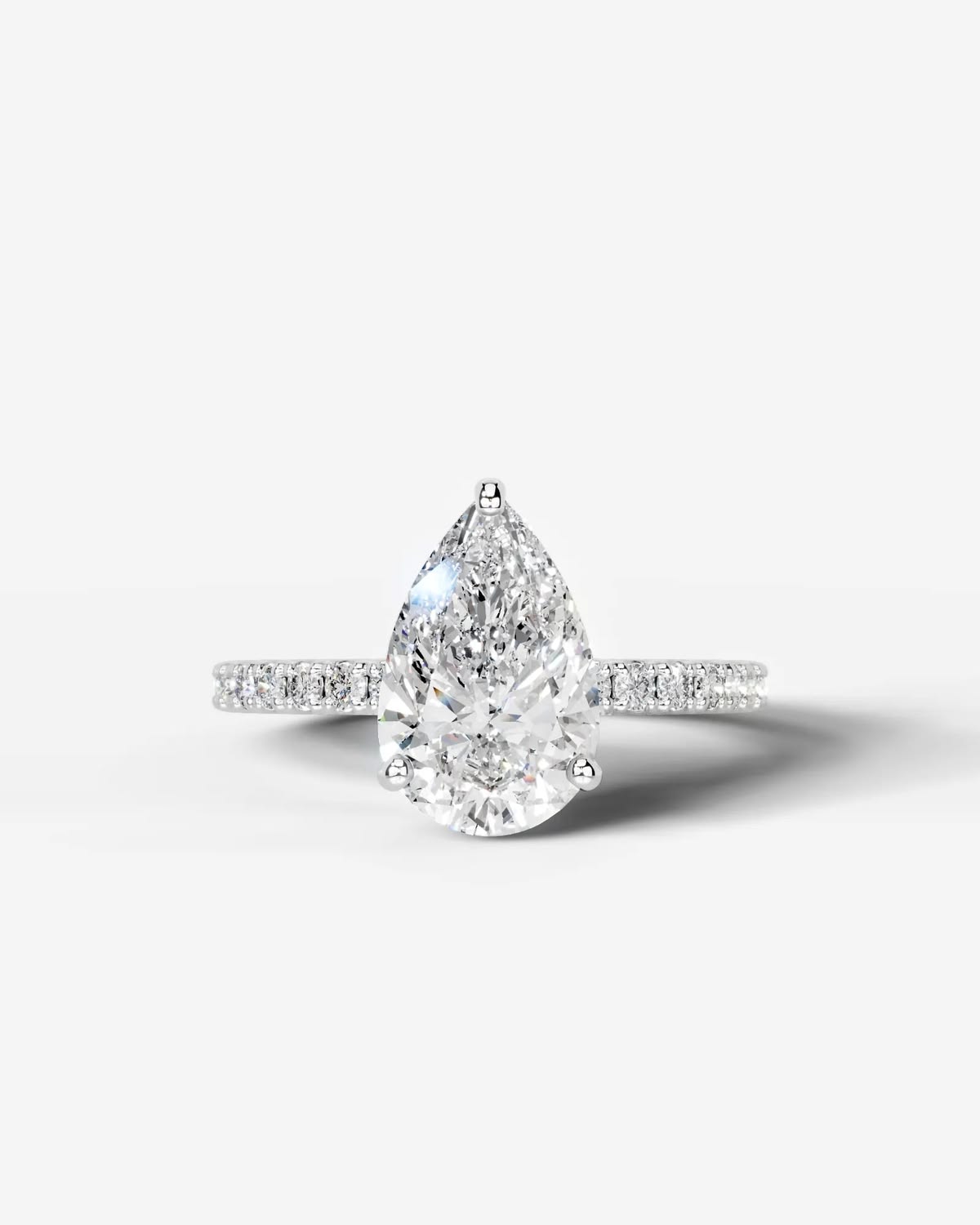
A diamond's sparkle is not an accident. It comes from geometry: the angles, proportions and finish of a few dozen tiny mirrors. This guide walks through the parts of a diamond, shows what makes one stone lively and another dull, and explains the four things every certificate describes: clarity, cut, colour and carat.
The anatomy of a diamond
Seen from the side, a classic round brilliant has five named parts. Graders measure how they relate to each other, and those proportions decide how well the stone handles light.
- Table — the large flat facet on top. Its width is quoted as a percentage of the stone's width.
- Crown — the upper part, from the table down to the edge. Its height and angle shape the stone's "fire", the flashes of colour.
- Girdle — the thin edge around the widest point, where the stone is held by the setting. Too thin risks chipping; too thick adds weight you cannot see.
- Pavilion — the lower part that tapers to a point. Its angle decides whether light is bounced back up.
- Culet — the tiny point or facet at the very bottom.
- Total depth — the height of the stone as a percentage of its width.
As a rough guide, a classic round brilliant often has a crown angle near 34° and a pavilion angle between 40.5° and 41°, with a total depth near 60%. These are guides, not rules: a certificate lists the exact numbers for the stone in front of you.
Why cut decides the sparkle
Light enters through the top of the diamond, travels to the pavilion, bounces off the facets and should return out through the top, towards your eye. How well that works depends on the angles.
This is why two diamonds of the same weight, colour and clarity can look very different. If you can only prioritise one of the 4Cs, make it cut.
Understanding the 4Cs when you shop
Every diamond is described by clarity, cut, colour and carat. None of them is "best" on its own: the aim is a balance that looks beautiful and fits your budget.
Clarity
Clarity describes the tiny natural marks inside and on the surface of a diamond, called inclusions and blemishes. The scale runs from Internally Flawless to Included. Most diamonds in the middle of the scale look clean to the naked eye, so you rarely need to pay for the top grades. What matters is whether the marks are visible without magnification, often called "eye-clean".
Diamond clarity descriptions
| Grade | What it means |
|---|---|
| FL / IF | Flawless has no inclusions or blemishes under 10x magnification. Internally Flawless has no inclusions, only tiny surface blemishes. Very rare. |
| VVS1 / VVS2 | Very, very slightly included. Minute inclusions that are hard to see even for a trained grader at 10x. |
| VS1 / VS2 | Very slightly included. Small inclusions, visible at 10x with some effort, but not to the naked eye in most stones. |
| SI1 / SI2 | Slightly included. Inclusions are easy to see at 10x. SI1 is often still clean to the eye; SI2 is worth checking in person. |
| I1 / I2 / I3 | Included. Inclusions are obvious at 10x and usually visible to the naked eye, and can affect brightness or durability. |
Cut and shape
Shape is the outline you see: round, oval, pear and so on. Cut is the quality of the proportions and polish inside that outline. For round diamonds, laboratories give an overall cut grade from Excellent to Poor. For other shapes there is usually no overall cut grade, so look at the polish and symmetry on the certificate, and above all at the stone itself.
Diamond cut descriptions
| Grade | What it means |
|---|---|
| Excellent | Light is returned through the top almost perfectly: maximum brilliance and fire. |
| Very Good | Nearly as lively as Excellent, often at a lower price. Hard to tell apart by eye. |
| Good | Reflects most light, but some escapes. A fair compromise on a tight budget. |
| Fair / Poor | A noticeable amount of light escapes. The stone can look dull or glassy. |
Colour
The colour grade measures how colourless a white diamond is, from D (no colour) to Z (light yellow or brown). The steps between neighbouring letters are subtle and mostly visible when stones are compared loose and side by side. In a ring, the metal matters too: near-colourless stones suit white gold and silver, while a slightly warmer stone can look lovely in yellow gold.
Diamond colour descriptions
| Grades | Range | What it means |
|---|---|---|
| D, E, F | Colourless | No visible colour. The rarest and most valued. |
| G, H, I, J | Near-colourless | Colour is hard to see once set. Very good value. |
| K, L, M | Faint | A slight warm tint, visible to a trained eye. |
| N to Z | Very light to light | Tint is easy to see. |
Carat (size)
Carat is weight, not size: one carat is 0.2 grams. Because most of a diamond's weight is in its depth, two stones of the same carat weight can look different from above. Price rises steeply at round numbers, so a 0.90 carat stone can look almost the same as a 1.00 carat stone for noticeably less.
Diamond size descriptions
| Carat weight | Approximate diameter (round) |
|---|---|
| 0.10 ct | 3.0 mm |
| 0.25 ct | 4.1 mm |
| 0.50 ct | 5.1 mm |
| 0.75 ct | 5.8 mm |
| 1.00 ct | 6.5 mm |
| 1.50 ct | 7.4 mm |
| 2.00 ct | 8.2 mm |
| 2.50 ct | 8.8 mm |
Diameters are typical for a well-cut round diamond and vary slightly from stone to stone.
Putting it together
A simple order of priorities works for most buyers: choose a good cut first, then a colour and clarity that look clean to your eye, and spend what is left on size. Then choose the setting and metal that suit the stone.
Not sure where to start? Browse our diamond rings, or message our team and we will talk you through a piece, the stone and the metal before you decide.